
The 2026 budget removed APL, ALF and ALS from most non-EU students starting 1 July 2026. The implementing decree is now published; this guide tells you exactly who is affected, what the narrow exceptions look like, and what to do if the CAF stops your payment.
The Caisse d'Allocations Familiales (CAF) is France's family benefits agency. Its housing allowance, officially the Aide Personnalisée au Logement (APL), is a monthly payment that reduces the effective cost of your rent. Until this summer it was one of the first stops for any Indian student arriving in France. From 1 July 2026, that changed for most non-EU students.
The 2026 Change: What Article 179 Now Says
The rule comes from article 179 of the loi de finances 2026 and its implementing décret n° 2026-552 du 27 juin 2026 (published in the Journal officiel on 28 June 2026 and in force from 1 July 2026).
What is now established:
- From 1 July 2026, non-EU / non-EEA / non-Swiss students are excluded from APL, ALF and ALS by default. Holders of EU, EEA or Swiss citizenship are not affected.
- The decree applies to every monthly payment from 1 July 2026 onwards, including payments on files that were already open before that date. Article 2 of the decree states: "Les dispositions du présent décret sont applicables aux prestations dues à compter du 1er juillet 2026." The decree contains no transitional provisions and no grandfather clause.
- The CAF is notifying affected beneficiaries by email, not quietly re-examining files in the background. Members of our community started receiving these notifications from early July 2026 onwards. The email is titled Fin de votre aide au logement, cites both article 179 de la loi n° 2026-103 du 19 février 2026 and article D. 821-1 du code de l'éducation, and names the date of the last CAF payment. For most beneficiaries flagged for closure in this first wave, the last payment lands on 6 July 2026. If you receive this email, do not delete it, it is the trigger point for the "what to do" checklist below.
- The exclusion applies to about 100,000 non-EU students, at an average of around €165 per month in lost aid, per press coverage of the government's impact assessment.
The narrow exceptions: who still receives APL
The CAF's own notification email spells out six categories that stay eligible after 1 July 2026. A non-EU student remains covered if they meet at least one of these:
- Bourse d'enseignement supérieur sur critères sociaux delivered by the CROUS. This is the primary exception cited by article 179. Only roughly 2 to 3% of non-EU students hold this bourse, so it is a small door.
- Professional activity, whether salaried or as an auto-entrepreneur. The CAF's practical test is documentary: a signed contract for the salaried case, a valid SIRET and real declared income for the auto-entrepreneur case.
- Contrat d'apprentissage or contrat de professionnalisation. Both alternance formats keep the aid.
- Étudiants réfugiés (students with refugee status).
- Apatrides (stateless students).
- Conjoints d'étudiants extra-communautaires (spouses of non-EU students who are themselves excluded).
Campus France scholarships (Eiffel, embassy programmes, partner-country awards) are not the bourse sur critères sociaux and do not automatically qualify. If your only funding is a Campus France award, plan on losing APL unless one of the other five categories applies to you.
What to do if you receive the CAF email cutting off your APL
Here is what the actual notification looks like, so you can recognise it in your inbox:
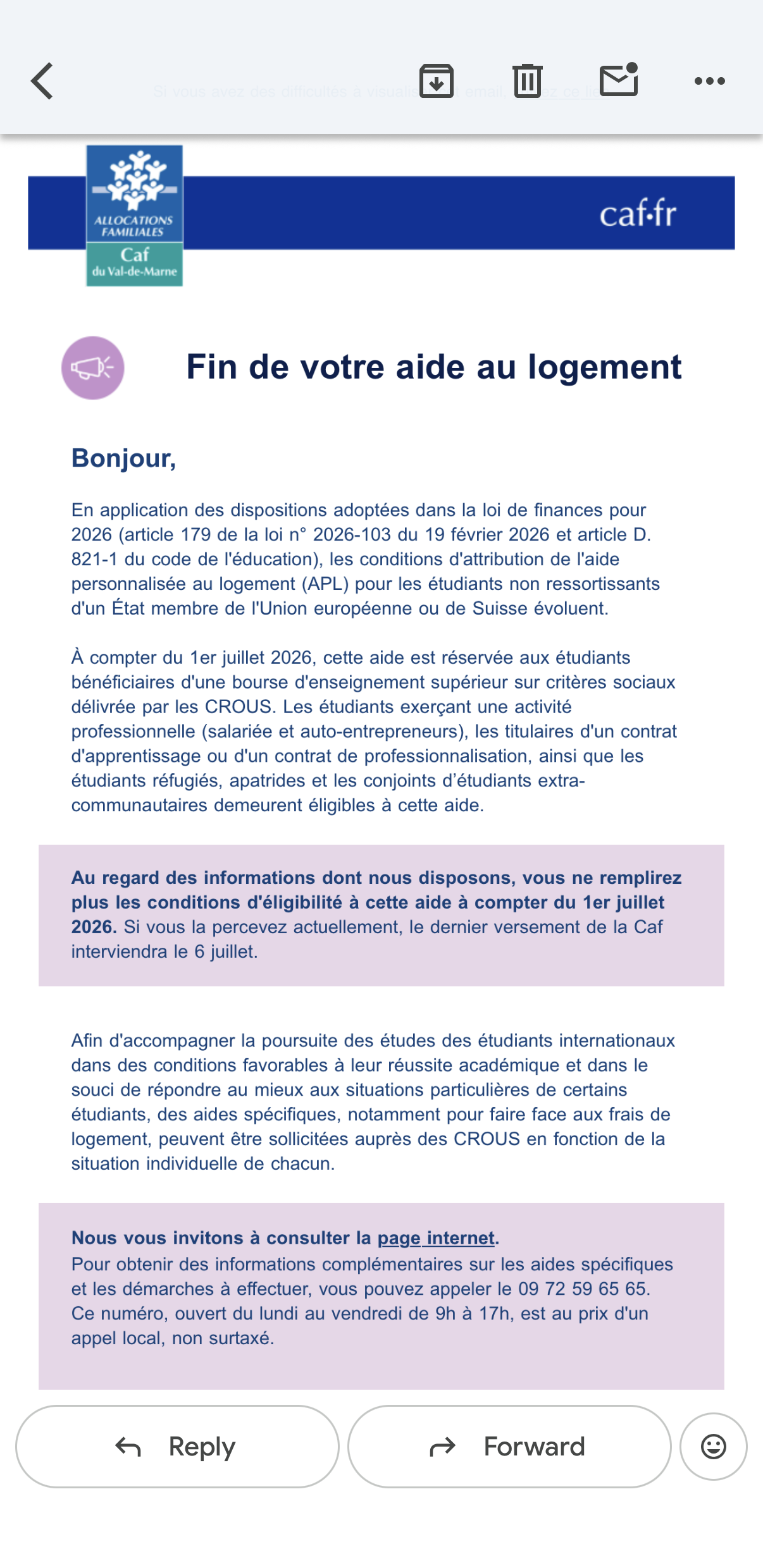
Once you have it:
- Read the email carefully. It states the legal basis (article 179 of loi n° 2026-103 and article D. 821-1 du code de l'éducation), the six exception categories, and the date of your last CAF payment. Screenshot it. Keep it.
- Check whether you qualify under one of the six exceptions. If you actually have a salaried job, run an auto-entreprise, hold a contrat d'apprentissage or de professionnalisation, hold a CROUS bourse sur critères sociaux, or are a refugee, apatride, or spouse of a non-EU student, and the CAF's decision does not reflect that, updating your file is the fastest route to reversing the cut.
- Log into Mon Compte on caf.fr, go to Déclarer un changement de situation, and upload the relevant proof: employment contract and payslips, SIRET and auto-entrepreneur declarations, contrat d'apprentissage or de professionnalisation, bourse notification, or the status certificate for refugee / apatride / spouse cases.
- Upload as much supporting evidence as you have and keep proof of the upload date; that date is what a reinstatement decision will use to determine the month payments resume.
- Ask the CAF's dedicated line on 09 72 59 65 65 (Monday to Friday, 9h to 17h, standard call rate, not surtaxé) if you have questions about your specific case or need help understanding the letter.
- If you cannot fit any of the exceptions, plan for the €150 to €200 per month gap starting from the month after the last payment named in the CAF email. That is money that has to come from your family (LRS transfer), a part-time job or an auto-entreprise setup (which then makes you eligible again), or your own savings. The email itself signposts that CROUS may offer complementary aid to international students facing housing costs, ask your local CROUS what is available for your situation.
Where to get help if you want to contest the decision
FranceMitra does not provide legal advice. If the CAF's decision looks wrong to you (they missed your contract, misread your bourse notification, or classified you incorrectly), there are recognised free routes to challenge it. Below is a signpost to the official structures. Use them to get advice from someone qualified to give it before you take any procedural step.
- First contact: the CAF itself. The initial réclamation is free, and can be started from your Mon Compte on caf.fr or in person at a CAF point d'accueil. Ask them to re-examine the file and to explain the motif of the decision.
- CAF médiateur administratif. Every CAF branch has an internal médiateur, an impartial officer bound by professional secrecy. The service is free and can help you engage with the CAF before escalating. Contact details are on your local caf.fr page.
- Défenseur des Droits. An independent constitutional authority that handles complaints against public services, including the CAF. Free, no lawyer required, no deadline to file. Complaint form: formulaire.defenseurdesdroits.fr.
- Formal challenge routes (recours amiable, then judicial appeal) exist under the Code de la sécurité sociale, with strict deadlines from the date you receive the CAF's decision. Because the deadlines and the correct court change with your situation, use one of the free legal aid points below to have your specific case reviewed before you file anything.
- Free legal advice, in person:
- France Services (france-services.gouv.fr), a national network of one-stop public-service hubs, offers free help with CAF paperwork and appeal drafting.
- Points d'accès au droit and Maisons de Justice et du Droit offer free consultations with lawyers. Locate the nearest one via justice.fr.
- Aide juridictionnelle (state-paid legal representation) is available if you are below the current income threshold. Apply through the tribunal or online.
Whatever route you follow, keep every document: the CAF email or letter, screenshots of your Mon Compte pages, proof of any evidence you upload, and any subsequent correspondence. Those documents are what a qualified adviser will need to help you.
Standard APL conditions
Article 179 is one gate; there is a second, older gate you also have to clear. These are the baseline APL rules that have always applied and still apply. If you fit one of the six article 179 exception categories above, confirm you also meet all of the following before applying.
- Valid residency status: you hold a current titre de séjour, or a VLS-TS that you validated online through the ANEF portal within the 3-month window. CAF asks for proof of legal residence, not specifically for proof of timely validation.
- Your accommodation is your main residence in France. Not a holiday let, not a sublet.
- You are named on the lease as tenant or co-tenant. If your name is not on the contract, CAF will not pay.
- You have a French bank account with a SEPA-compatible IBAN. CAF pays in euros, directly to your French account; an NRE account in India cannot receive APL. You need your RIB ready.
- You live in qualifying housing. Most rental accommodation qualifies, including CROUS residences. Note that the CROUS residence itself does not exempt you from article 179; if you live in a CROUS room, you still need to fit one of the six exception categories to receive APL there. The CROUS is only the administrative channel through which the aid is paid.
How to Apply
The entire application is online at caf.fr. There is no physical office visit required. You will need your lease, your RIB (French bank account details), proof of your residency status, and basic income information. CAF calculates your benefit amount based on your rent level, income, and city.
Apply as soon as you have signed your lease. APL is paid from the first day of the month following your application, not from your lease start date. Every month of delay between signing your lease and submitting your CAF application is a month of APL you simply do not receive. There is no backdating to the start of the tenancy.
Heads up on who actually receives the money: APL is typically paid directly to your landlord via tiers-payant in conventionné housing (the DILA F12006 wording: "directement versée à votre bailleur"), and the landlord deducts the APL amount from the rent you owe. ALS (the alternative aid for non-conventionné rentals) is more often paid to the tenant. CROUS residents have the aid netted off their monthly bill automatically. Confirm the payment arrangement with your landlord or CROUS before moving in so you know whether to pay the full rent or only your share.
The India Angle: What Your Parents Will Ask
This section is for students who meet one of the six article 179 exceptions and are actually receiving APL, or expect to. If article 179 excludes you, skip ahead to the adjacent-support section below.
Back home, the concept of a government agency simply paying a portion of your rent every month is unusual enough that your family may be suspicious of it. It is not a scam. It is a standard part of the French social welfare system, funded by payroll taxes. Millions of French nationals, students, and working adults receive it.
A few India-specific notes worth having ready.
APL and Indian tax. Indian tax treatment of foreign social benefits depends on your residency status under the Income Tax Act and on the India-France double-taxation treaty. Talk to a CA who knows NRI returns before you assume APL is or is not declarable.
APL reduces your effective housing cost. If you are transferring funds from India to cover rent, factoring in your APL means you may need to transfer less. Under the LRS framework, keeping annual transfers below the threshold that triggers the TCS surcharge avoids it; APL can meaningfully reduce how much your family needs to send.
No apostille is needed for your Indian documents to apply to CAF. Unlike visa applications (which require MEA apostille on educational documents), CAF typically requires only a certified translation of your birth certificate if they request it at all.
If You Are Not Eligible: Adjacent Support, Not Substitutes
If article 179 excludes you, APL is no longer available. None of the supports below is a full replacement; each addresses a different need.
- CROUS complementary aid for international students. The CAF's own notification email signposts this route: CROUS may offer specific housing aid for international students facing budget difficulty on a case-by-case basis. Ask your local CROUS service social what is currently available for your situation, and bring your CAF notification email with you.
- Visale (visale.fr), a free guarantor service for tenants without a French guarantor. It helps you get past the landlord's garant requirement; it does not reduce your rent.
- CROUS social grants (bourses sur critères sociaux). These are annual income-based grants for higher-education students that the CROUS pays in monthly instalments. They are also the scholarship category article 179 references for APL eligibility, so they intersect: if you receive one, you regain APL eligibility.
- University emergency / hardship funds. Most French universities and grandes écoles hold a small discretionary fund administered by the service des affaires étudiantes. These are one-off payments, not monthly rent assistance.
If APL stops applying to you, the realistic expectation is that you will absorb a larger share of your rent yourself. For most Indian students on a VLS-TS without a bourse or a part-time job, this is a €150 to €200 monthly hit that shifts to the LRS transfer your family sends. Plan your budget from the start of the academic year with APL out of the equation unless you know you meet one of the six exception categories.
This guide was drafted from verified sources. Always confirm details on the official website before taking action.
Questions People Actually Ask
Direct answers to the most common doubts about this process.